Build a Long-Range Wireless Appliance Control System
Controlling electrical devices over long distances is often challenging, especially when internet connectivity is unreliable or unavailable. This project demonstrates a practical solution using LoRa communication, enabling you to operate appliances like lights and fans from a smartphone—even across large distances—without relying on Wi-Fi or complex networking.
By combining LoRa with Bluetooth Low Energy (BLE) and a microcontroller such as Arduino Nano, this system creates a bridge between short-range mobile interaction and long-range wireless transmission.
Components Required
- Arduino Nano (2 units)
- Reyax RYLR999 LoRa + BLE Module (2 units)
- 5V Bidirectional Voltage Level Shifter (2 units)
- 16×2 I2C LCD Display (2 units)
- 2-Channel Relay Module (2 units)
- Jumper Wires
- USB Cable (for programming)
- 12V Power Adapter
- 12V DC Fan and AC Bulb (load for testing)
Reyax RYLR999 Module Overview and Pinout
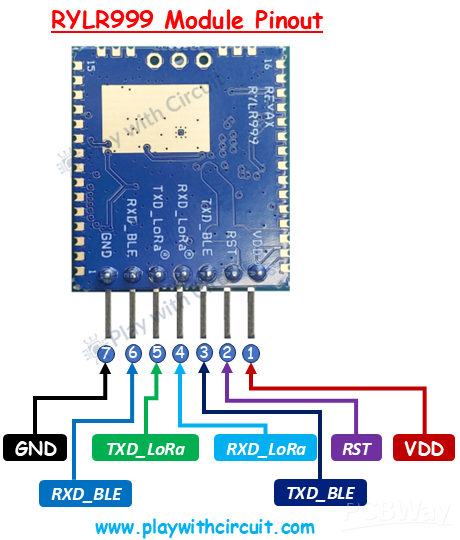
The Reyax RYLR999 module is the core communication unit of this system, combining both BLE and LoRa capabilities into a single compact module. This dual-function design allows it to act as a bridge between a smartphone and a remote device.
On one side, it receives commands from a mobile app via BLE, which serves as a user-friendly interface. On the other side, it transmits these commands over long distances using LoRa communication. This makes it possible to control devices located far away without internet dependency.
The module includes essential pins such as power (VDD), ground (GND), reset (RST), and separate UART pins for BLE and LoRa communication. Dedicated transmit and receive lines allow seamless serial communication with the microcontroller, ensuring reliable data exchange in both short-range and long-range modes.
Project Overview / Working Principle
The system is divided into two sections: a controller unit and a target unit. The controller side acts as the command transmitter, while the target side executes the received instructions.
On the controller side, a smartphone connects to the RYLR999 module via BLE. When a user sends a command (for example, turning a light ON), the module receives this data and forwards it to the microcontroller. The microcontroller processes the command and transmits it using LoRa to the remote module.
At the target side, another RYLR999 module receives the LoRa signal and passes the data to a second microcontroller. Based on the received instruction, the controller activates a relay module to switch appliances ON or OFF. This setup ensures reliable long-distance control with minimal power consumption.
Hardware Setup Explanation and Connections
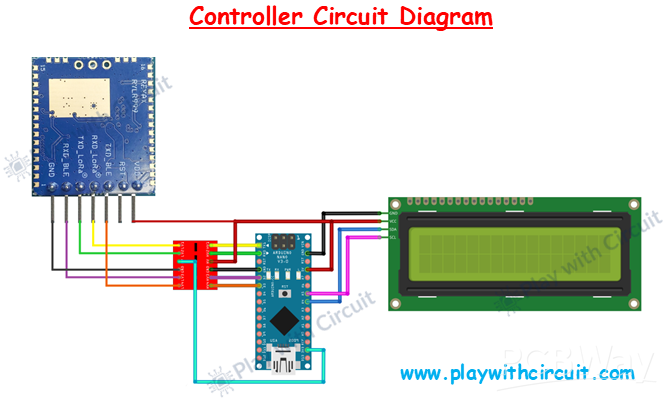
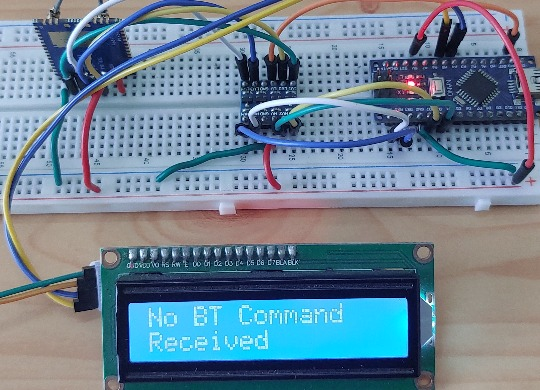
On the controller side, the RYLR999 module communicates with the Arduino Nano through serial communication. Since the module operates at 3.3V logic and the Arduino uses 5V logic, a bidirectional voltage level shifter is required to safely interface the signals. The BLE communication is handled through software serial pins, allowing the Arduino to manage both BLE and LoRa communication simultaneously. The LoRa transmit and receive pins are connected through the level shifter to ensure proper voltage compatibility.
An I2C LCD is connected using SDA and SCL pins to display system status, such as received commands and communication feedback.
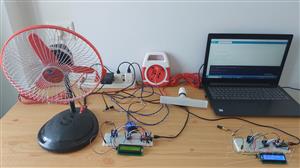
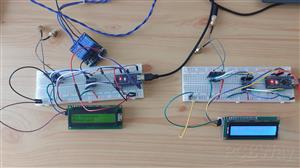
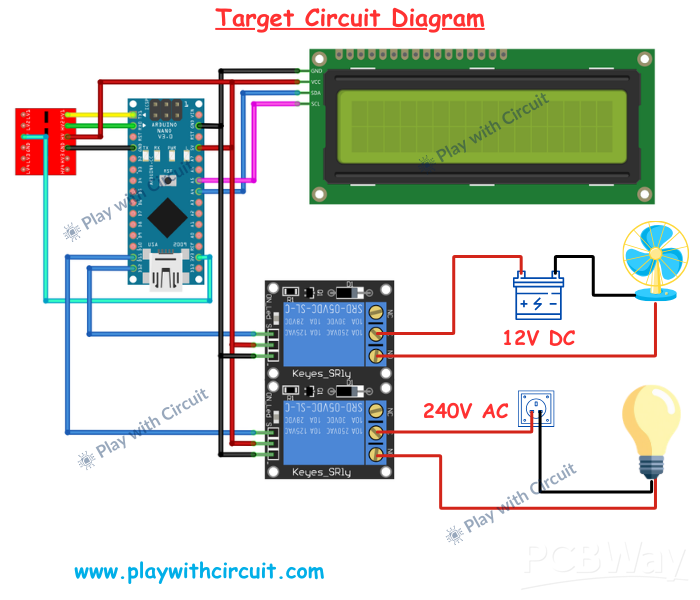
On the target side, the setup is similar but includes an additional relay module. The relay is connected to digital output pins of the Arduino, allowing it to control external loads. When a command is received, the Arduino triggers the corresponding relay channel to switch appliances like a fan or bulb. Proper grounding between all components is essential to maintain stable communication. The relay module ensures safe isolation between low-voltage control circuitry and high-voltage appliances, making the system reliable for real-world usage.
Video
Conclusion
This project demonstrates how LoRa technology can be effectively used to build a reliable long-range control system without internet. By integrating BLE for user interaction and LoRa for communication, it creates a flexible and scalable solution for remote automation.
Such systems can be extended further for smart agriculture, industrial automation, and remote monitoring applications, especially in areas with limited connectivity.
For complete step-by-step instructions and code, check the full guide here: https://playwithcircuit.com/long-range-appliance-control-from-smartphone-using-arduino/
Build a Long-Range Wireless Appliance Control System


Attribution-ShareAlike (CC BY-SA) License
Read More⇒




Raspberry Pi 5 7 Inch Touch Screen IPS 1024x600 HD LCD HDMI-compatible Display for RPI 4B 3B+ OPI 5 AIDA64 PC Secondary Screen(Without Speaker)
BUY NOW


- Comments(0)
- Likes(0)
More by Rachana Jain
-
 Arduino Water Level Indicator Using Water Level Sensor
Monitoring water levels in tanks is important for preventing overflow and reducing water wastage. In...
Arduino Water Level Indicator Using Water Level Sensor
Monitoring water levels in tanks is important for preventing overflow and reducing water wastage. In...
-
 Arduino Servo Motor Control
Precise motion control is at the heart of many modern electronics projects—from robotic arms to came...
Arduino Servo Motor Control
Precise motion control is at the heart of many modern electronics projects—from robotic arms to came...
-
 Build a Long-Range Wireless Appliance Control System
Controlling electrical devices over long distances is often challenging, especially when internet co...
Build a Long-Range Wireless Appliance Control System
Controlling electrical devices over long distances is often challenging, especially when internet co...
-
 DHT11 and DHT22 Sensors with Arduino Uno
Temperature and humidity monitoring plays a crucial role in various applications, from smart home cl...
DHT11 and DHT22 Sensors with Arduino Uno
Temperature and humidity monitoring plays a crucial role in various applications, from smart home cl...
-
 Line Follower Robot using Arduino
A Line Follower Robot (LFR) is an autonomous robot that follows a predefined path, typically a black...
Line Follower Robot using Arduino
A Line Follower Robot (LFR) is an autonomous robot that follows a predefined path, typically a black...
-
 Ultrasonic Sensor HC-SR04 Interfacing with Arduino
The HC-SR04 Ultrasonic Sensor is a widely used and easy-to-implement sensor for distance measurement...
Ultrasonic Sensor HC-SR04 Interfacing with Arduino
The HC-SR04 Ultrasonic Sensor is a widely used and easy-to-implement sensor for distance measurement...
-
 Interfacing IR Sensor Module with Arduino Nano
In this project, we will learn how to interface an Infrared (IR) sensor module with an Arduino Nano....
Interfacing IR Sensor Module with Arduino Nano
In this project, we will learn how to interface an Infrared (IR) sensor module with an Arduino Nano....
-
-
ARPS-2 – Arduino-Compatible Robot Project Shield for Arduino UNO
2531 0 5 -
A Compact Charging Breakout Board For Waveshare ESP32-C3
2986 3 8 -
AI-driven LoRa & LLM-enabled Kiosk & Food Delivery System
3193 2 1 -
-
-
-
ESP32-C3 BLE Keyboard - Battery Powered with USB-C Charging
3259 0 2